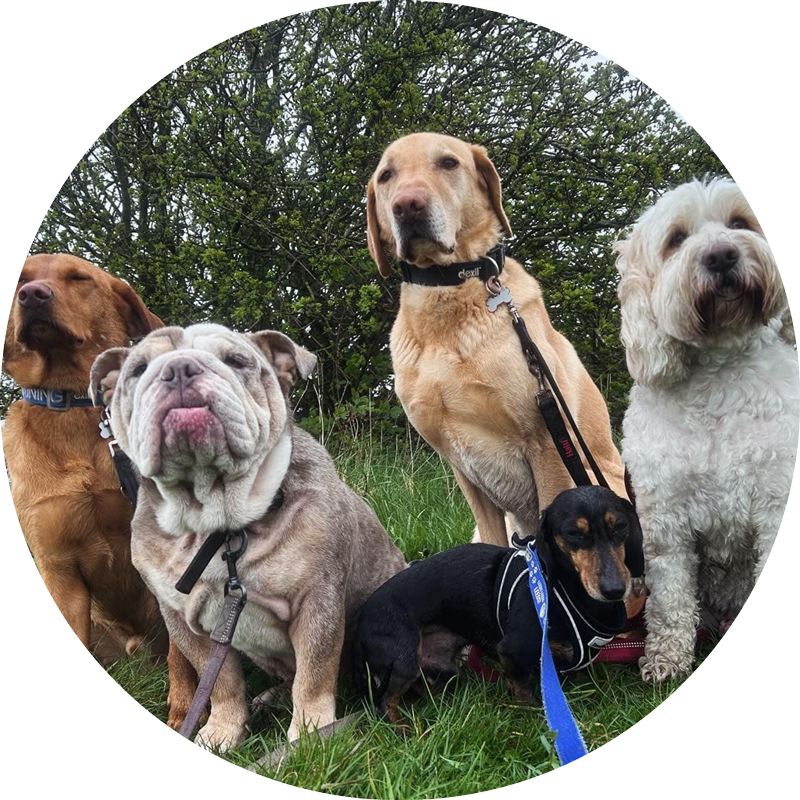
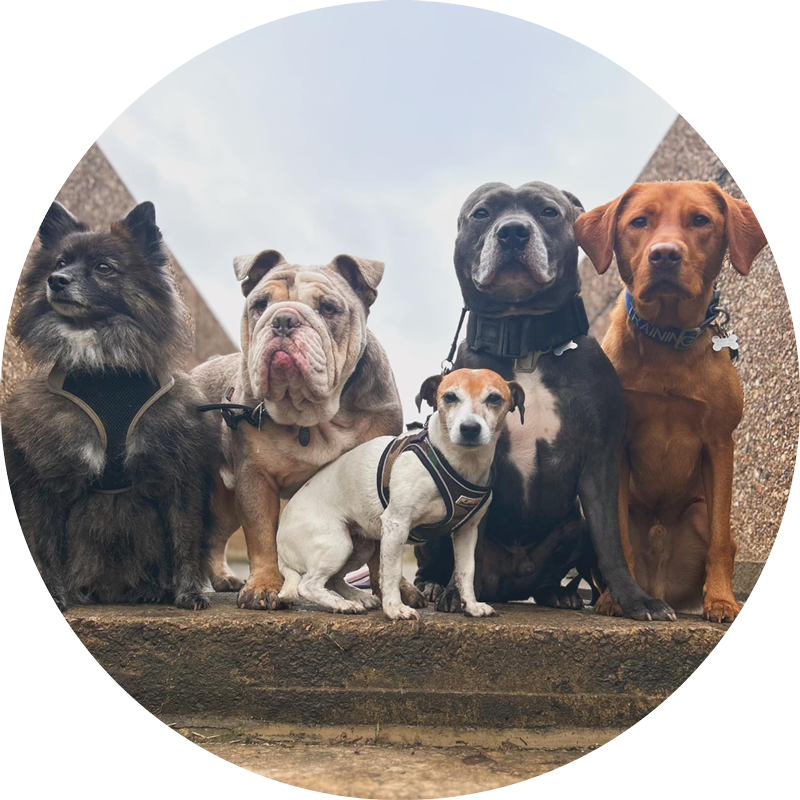
If you’ve ever lived with more than one dog, you’ve probably witnessed a surprising phenomenon: the dogs that seem to have the least in common are often the ones that form the strongest bonds.
I regularly refer to my boys as my Chalk and Cheese- 2 rescue bulldogs, both abandoned (and adopted) in the prime of their adolescence with only 2 years between them in age.
Yet they are opposites in so many ways: their motivations, their social skills with people and with dogs, their engagement levels with me, their training needs, their boundaries, their anxieties and worries…the list is endless.
The question is why do these dogs get on so well?
The answer lies in understanding that friendship isn’t always about similarity.
At the start I definitely had to put the groundwork in. Perry arrived as a bit of a hooligan with zero boundaries. Clarence is a super tolerant lad but also struggles with self- regulation once over stimulated. There were many months of managing behaviours before we got to the brotherhood we now have.
It was 18 months until they were alone without supervision. They still had separate walks, separate affection, lots of training together (and apart) and I observed them permanently to ensure I advocated for either if it was needed.
My role was to ensure their difference in personalities was respected to ensure successful coexistence and it definitely paid off.
Different Doesn’t Mean Incompatible
Humans often assume that individuals with similar personalities will naturally get along best. While that can be true, dogs don’t necessarily approach relationships the same way.
Dogs tend to focus less on shared interests and more on how another dog makes them feel.
A calm dog can provide reassurance to a nervous companion. A confident dog can help an uncertain dog explore new situations. A playful dog can encourage a quieter dog to engage with the world.
Instead of competing, they complement each other.
Balance Creates Harmony
Many successful canine friendships work because each dog fills a different role.
Imagine two highly energetic, impulsive dogs living together. Their excitement can continuously feed off one another, sometimes leading to overstimulation.
Now imagine a lively dog paired with a calm and thoughtful companion. The calmer dog often acts as a stabilising influence, helping keep interactions balanced.
Likewise, a cautious dog may benefit from observing a confident dog navigate unfamiliar situations safely. The confident dog becomes a source of information and reassurance.
In many cases, their differences create harmony rather than conflict.
Dogs Judge Character, Not Appearance
Humans can become preoccupied with breed, size, age, or background. Dogs are generally far less concerned.
A large dog may happily bond with a tiny companion. A rescue with a difficult past may become best friends with a puppy who has never experienced hardship.
Dogs communicate primarily through behaviour and body language. They pay attention to signals such as respect, predictability, play style, and emotional stability.
As long as communication is clear and both dogs feel safe, differences often become irrelevant.
Shared Experiences Matter More Than Similar Personalities
Some of the strongest bonds develop because dogs experience life together.
They share walks, routines, adventures, challenges, and quiet moments at home. Over time, familiarity creates trust.
This is particularly noticeable in rescue dogs. Two dogs may arrive with completely different histories and temperaments, yet develop a close relationship because they learn to navigate their new world side by side.
The bond grows from shared experiences rather than matching personalities.
They Learn from Each Other
Dogs are excellent social learners.
A nervous dog may watch a confident companion greet visitors calmly and begin to copy that behaviour. A young dog may learn patience from an older dog. An excitable dog may gradually mirror the relaxed attitude of a laid-back friend.
The relationship becomes mutually beneficial.
Rather than being hindered by their differences, dogs often use those differences as opportunities to learn and adapt.
Respect Is More Important Than Similarity
The healthiest canine relationships are rarely built on being identical.
They are built on mutual respect.
Dogs that understand each other’s boundaries, communicate clearly, and trust one another can form strong friendships regardless of age, breed, size, or temperament.
In fact, some of the most successful pairings occur because neither dog is trying to occupy the same social role within the household. A notion I often explain in ‘in house’ aggression cases where clients often assume dogs are competing for ‘top dog’ prize.
The Beauty of Unlikely Friendships
There is something special about watching two completely different dogs choose each other.
The ‘choice’ is imperative here. Often owners will force dogs to play, interact and share beds etc when it’s really not necessary. Dogs will often figure out the boundaries and can still respect each other without being velcro’d to each other. The last thing we need to create is dogs who are too reliant on each other.
Companionship is not always about finding someone exactly like ourselves. Sometimes it is about finding someone whose strengths balance our weaknesses, whose confidence supports our uncertainty, or whose calmness helps settle our excitement.
Dogs seem to understand this naturally.
Dogs mainly judge each interaction on its own merits, forming connections based on trust, safety, and shared experience.
Perhaps that’s why some of the most heartwarming friendships are between dogs that, on paper, should never have become friends at all.